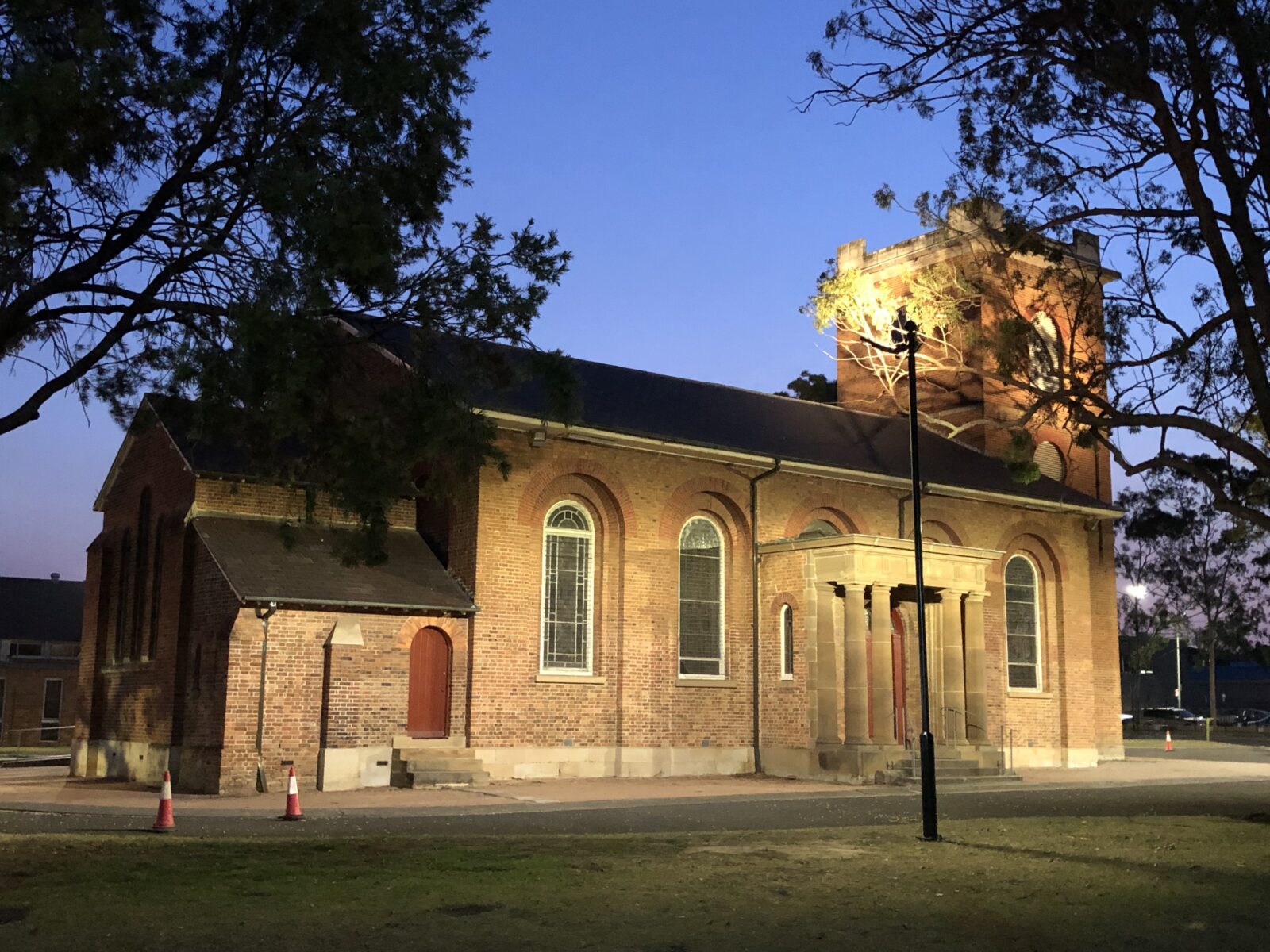
St Luke’s Anglican Church in Liverpool isn’t just another old church. It is the oldest still-standing Anglican church building in Australia! Now, thanks to a host of important building works and a congregation that’s excited for the future, there’s plenty of life and activity ahead for this 200-year-old community.
Built from 1818 to 1820, St Luke’s was commissioned by Governor Lachlan Macquarie and designed by Francis Greenway, a convicted forger turned colonial architect.
Today the site supports a range of ministries, including four main services each Sunday – three English speaking and one Nepalese. The church has also just started a Vietnamese speaking congregation and an Indian dialect congregation. There’s also a children’s ministry, youth group and a community chaplain co-funded by Anglicare who works full time on site. The chaplain runs life skills courses and Bible studies, as well as a monthly Wednesday church service for those coming out of drug court and other difficult situations. And if that’s not enough, the church also runs English language skill classes, holiday kids’ club programs and a regular playgroup!
The church site also gets used intermittently by the Liverpool Council for set up and pack down of activities being run in Macquarie Street Mall. Importantly, St Luke’s has an excellent working relationship with the council, which has made completing all the different building projects the church has undertaken lately a lot smoother.
As Michael Baker – a St Luke’s warden since 2002 – explains: Lots of people in Liverpool see the church daily, or walk through the open grassy site. But once they engage with the ministries being run at St Luke’s, they also realise there’s a live and thriving community looking outward to serve the community around them.
“Being right in the heart of Liverpool CBD means we have ministry opportunities right on our doorstep. The site is being used all through the week, and really our goal is to invest in the upkeep of the site so it can be used for ministry.”
Michael has been part of the team focusing on uplifting and developing the site to support ministry.
The last two decades in particular have seen some significant changes to the site. In 2010 the church demolished an old residence on site and extended the ministry centre to achieve more ministry space with two big new ministry rooms, new offices and a new car park. This dramatically increased the capacity of the site to support ongoing ministry.
Sydney Anglican Property has walked alongside and supported the team, particularly in applying for grants to support projects. “Since 2016 we’ve won 10 grants and have been able to deliver 11 projects from those grants,” Michael explains.
About half those projects focused on maintaining the site and its complex heritage-listed buildings, including re-roofing a hall, resurfacing roadways, redoing bathrooms and other tasks to keep the site functional. The other half of the projects have focused on what Michael describes as ‘uplift.’
“Within our ministry centre, for example, we’ve put in a stage, converting what was an empty hall into a multipurpose function space with AV, carpeting and lighting. So now we really have two spaces where we can run church services.”
SAP’s help has been invaluable to the church in getting these projects done, Michael says. “They always do a fantastic job in guiding us. They don’t trip us up with bureaucracy, but help us navigate it.”
In 2026, St Luke’s faces another challenge: the floor of the church building is collapsing. “It’s a big floor, and it’s 208 years old,” Michael explains. There’s been patch repairs, but the timber work is now riddled with termites and dry rot. Many of the brick piers have collapsed and sagged. When you walk across the floor at St Luke’s, you will notice it is uneven, and bounces in odd spots. More patch repairs were no longer an option.
“We identified that problem about two years ago, and since then we’ve been getting the damage assessed with building inspections and getting a plan in place with input from heritage architects and structural engineers, as well as applying for a very large grant from the NSW Government.”
Last year, the church was successful in securing a $300,000 grant under the ‘Caring for State Heritage’ program, the maximum grant they could get from Heritage NSW, towards the $600,000 total cost. As for the gap, amazingly, St Luke’s was able to commit to this project without needing to fundraise within the church. They deliberately chose to keep the congregation focused on giving generously to fund ministry, not properties. So how did they pay for all this work?
Answer: Foresight and good stewardship.
In the 1970s, St Luke’s sold some land to Westfield, and the money from that sale has been held in a trust fund, generating income to be used on property development. “We basically use that annual income to save up for big projects, which we supplement with grants,” Michael explains. The church is deeply grateful to God for the wisdom and foresight of previous generations!
The work on the church floor has now started, with services temporarily relocated to the Blackett hall, another heritage building on the site that the church has already spent time and money restoring and maintaining. “We’re very fortunate to have three spaces – the ministry centre, the Blackett hall and the church,” Michael says. Our site maintenance program is about uplifting those three spaces so we can run ministry continually and grow the ministry.”
Michael and the team have a very clear understanding of their responsibilities as custodians of a heritage site, and have found engaging with experts very beneficial. “We’ve got a great relationship with a heritage architectural firm that we have always used, and we’re using them again on our current floor project,” Michael shares. “And SAP is who we go to for advice around our legal obligations, the contractual side and the financial side of managing big grants. The kinds of things the average warden or parish councillor has no idea about, we lean on SAP to make sure we’re doing the right things in the right order.”
Michael sees the priorities of a warden managing church property as unfolding in three steps. “One, our first priority is making sure the site is safe for people to use. The second is maintaining the facilities we’ve got, and the third is future planning, for how to use the site and how to fund the work that needs to be done.”
According to Michael, underpinning all of that, is the need to ensure that the assets and physical buildings of a church site are existing to serve ministry, and not the other way around. “Property isn’t ministry, but ministry needs property,” Michael says. “We don’t want to be so focused on maintaining and building property portfolios that we forget to do ministry. But to do ministry effectively in our community we need to have wisdom around maintaining and growing our property.”
Michael’s prayer for St Luke’s and other Anglican churches is that they would be presenting the gospel of Jesus clearly and doing everything wisely to God’s glory – including managing their property – to see people coming to faith. “That is what I want people to pray for us, and that is what we are praying for others,” he says.