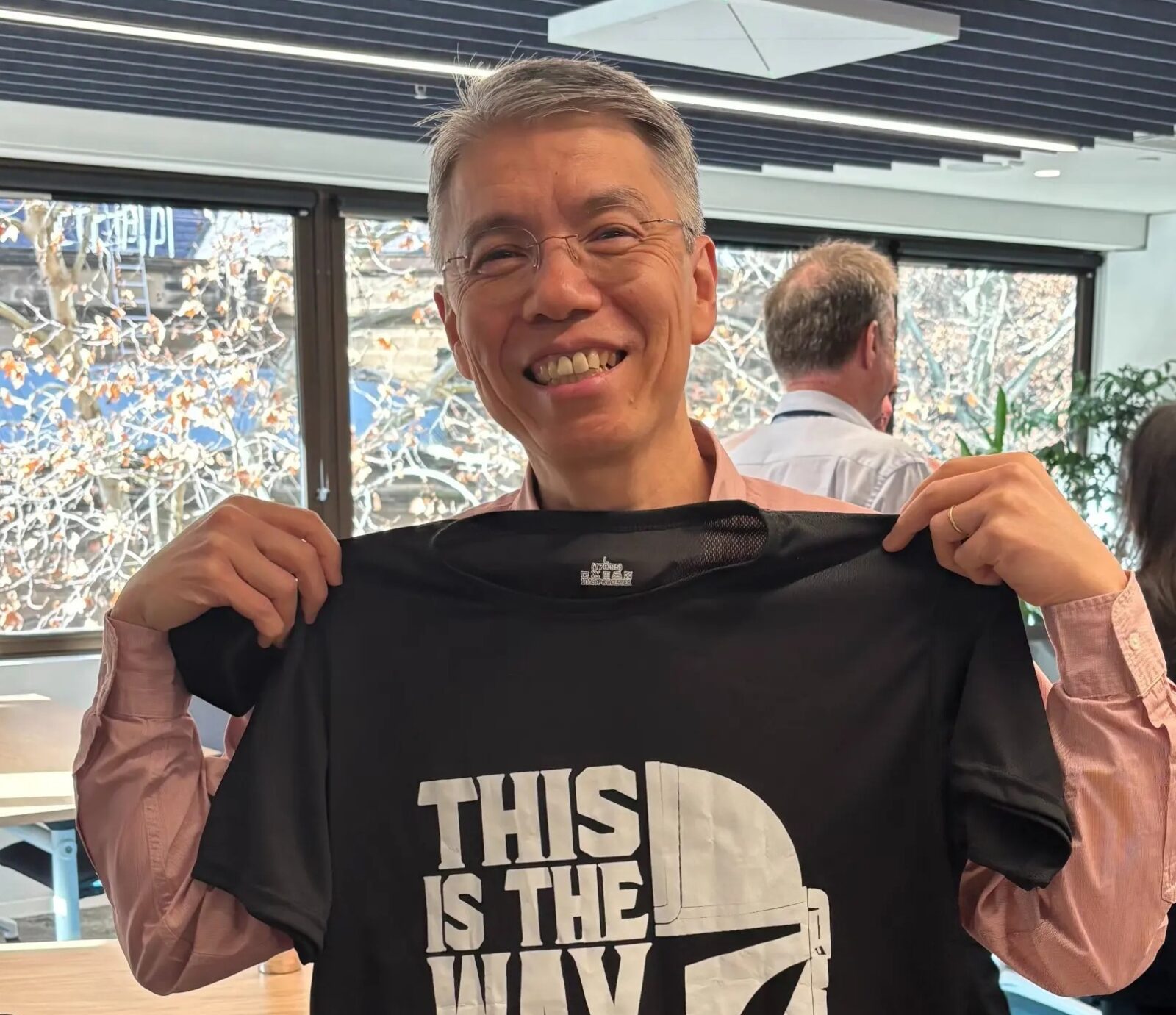
As SAP’s Chief Financial Officer (CFO) John Lau anticipates retiring at the end of this week, it closes a significant chapter of his life. Here he reflects on what brought him to Sydney Anglicans in the first place, and the vitally important mission opportunities he sees unfolding through the work of Sydney Anglican Property.
John Lau has worked as a CFO for many different organisations since 1998. But just four years ago, as he was thinking about concluding his working life, he saw a job ad that would change his life.
“At the time, I was finishing up at my previous job,” John explains, “But I saw this ad for a job at Sydney Anglican Services (SAS) and it made me think, ‘Hang on a minute, is this actually God telling me I need to use the gifts he has given me for his purposes?’
“I vividly remember standing in St Andrew’s Cathedral ahead of the job interview, saying to God, ‘If this is what you want me to do, then please make it so.’”
God did make it so, and in 2022, John embarked on his journey to serve the church.
A significant and positive change
Once he had started with the SAS team, he quickly realised that the management of church property was where the greatest complexities lay.
“That’s where the greatest risks were,” John reflects. “But also enormous opportunities.”
Soon, John was playing a key role in the formation of Sydney Anglican Property (SAP), which took four existing property-related organisations and combined them into one coherent unit.
Through this process, John witnessed significant and positive change. He notes that bringing these property responsibilities under one umbrella was one of the best operational decisions the Diocese has ever made.
“Prior to that, we had three groups of people responsible for property, plus another one looking to fundraise for new building projects,” John explains. “When you’ve got all these different groups of people doing property work, they can tend to trip over each other rather than working seamlessly together.”
For the last two and a half years, John’s work has focused on partnering with SAP, particularly CEO Ross Jones, to provide whatever support was needed as the four groups became one. Having one central board responsible for all property matters has allowed a coordinated approach.
“There’s far greater alignment now because we’ve got all the right people together in one team,” John says. “Previously it was far more difficult to join the dots.”
From those working in heritage, to those specialising in commercial property holdings, from greenfields development to urban renewal and parish property maintenance, SAP now has a comprehensive pool of expertise to draw upon.
“The result is good property decisions.”
Playing a crucial role
Day to day, most of John’s role centred on problem solving.
“For example,” John explains, “We may need funding to acquire a greenfield site or to develop a property. I’ll work with the SAP team, our banking partners, Sydney Anglican Loans and other funders to assess the financial viability of the property transaction and determine an appropriate source of funding.”
It’s a very busy job, and no two days are quite the same. The only consistency is the 20 sets of audited financial statements and budgets that John and his team would prepare every year for the central organisations of the Diocese!
Despite the hectic pace and many different responsibilities, John has loved the challenge and rewards of the role.
“It’s been extremely fulfilling, as well as a great privilege and honour to be able to work with diocesan staff teams.
“They are just such a wonderful group of dedicated people who are all very much focused on our Christian mission.”
Prior to Sydney Anglicans, John spent most of his career working in the commercial world where his job was to enrich shareholders by generating profits, so the shift to a Christian organisation required a significant change of mindset.
John describes the difference in attitude as not just making money for the sake of financial enrichment, but making investments that allow those resources to be used for the advancement of the diocesan mission.
“I’ve been extremely fortunate to do this role – which is why I’m very glad I accepted God’s challenge to serve him,” John says.
Putting assets to work for mission
John is particularly proud of the recent work that has been done on the Diocese’s commercial property where SAP and other diocesan organisations have their workplace – St Andrew’s House at Town Hall.
As of December 2025, there are no commercial vacancies in the building, which means every part of that property asset is either serving the Diocese directly or generating income for the Diocese. “It is delivering historic returns that directly support gospel ministry in the Diocese,” John confirms.
As John finishes in this role, he often thinks about the parable of the talents, from Matthew 25.
“God has given us a wealth of resources, and those resources are to be used appropriately, and not to be buried. We should not be fearful about using the assets we have been given.
“If there’s one insight I would give, it’s that our predecessors took risks, just like in the parable of the talents. They invested wisely and they took appropriate risks to enable us to have what we have today.
“And ultimately, it’s now under our stewardship to use those assets wisely, so that the generations ahead can benefit from the use of property assets to enhance our Christian mission,” John shares.
“Don’t be reckless, but do not be afraid to be bold.”
John points to the fact that SAP has been able to use the money from the 2 per cent Land Acquisition Levy that parishes generously contribute to acquire three properties for future growth. Over the last year and a half alone, properties have been acquired in Appin, Orchard Hills, and Catherine Fields.
SAP is looking to build churches in these areas in the coming years, so the Diocese will already have an anchor in these communities as land is released and new homes are built.
“Waiting till new suburbs are fully established is to not only miss the boat from a mission point of view, it means we would be priced out of the market,” John says. “The approach the Diocese is taking in greenfield areas of our city is the wisest both financially and spiritually.
“Now we just need to fund the construction of churches on those properties!”
John wants to exhort the wider church to be thinking strategically, creatively and boldly about under-used church property assets. He describes the Diocese as asset-rich, but income-poor. According to John, only through taking some considered risks will we be able to generate more income that can go back into serving the church and the mission.
Speaking candidly, John says “Personally, I don’t see great benefit in holding on to properties that are appreciating in value just so that in 50 years’ time we can say they are worth three times what they are today. Particularly if they are not being utilised for ministry.
“I think that’s particularly problematic when, at this present time, there are severely under-resourced ministries trying to reach rapidly growing communities out of school halls or facilities that aren’t fit-for-purpose. We need more churches west of Parramatta.
“So, as a Diocese, we need to do a better job of matching our property resources to our ministry needs. Both of which are very substantial.”
When he looks at the future work of SAP, John can see unlimited potential to realise opportunities, build new churches and equip the Diocese financially for the next generations. John is confident that with its excellent leadership, innovative approach and dedicated staff team, SAP will be able to meet those challenges to the glory of God.