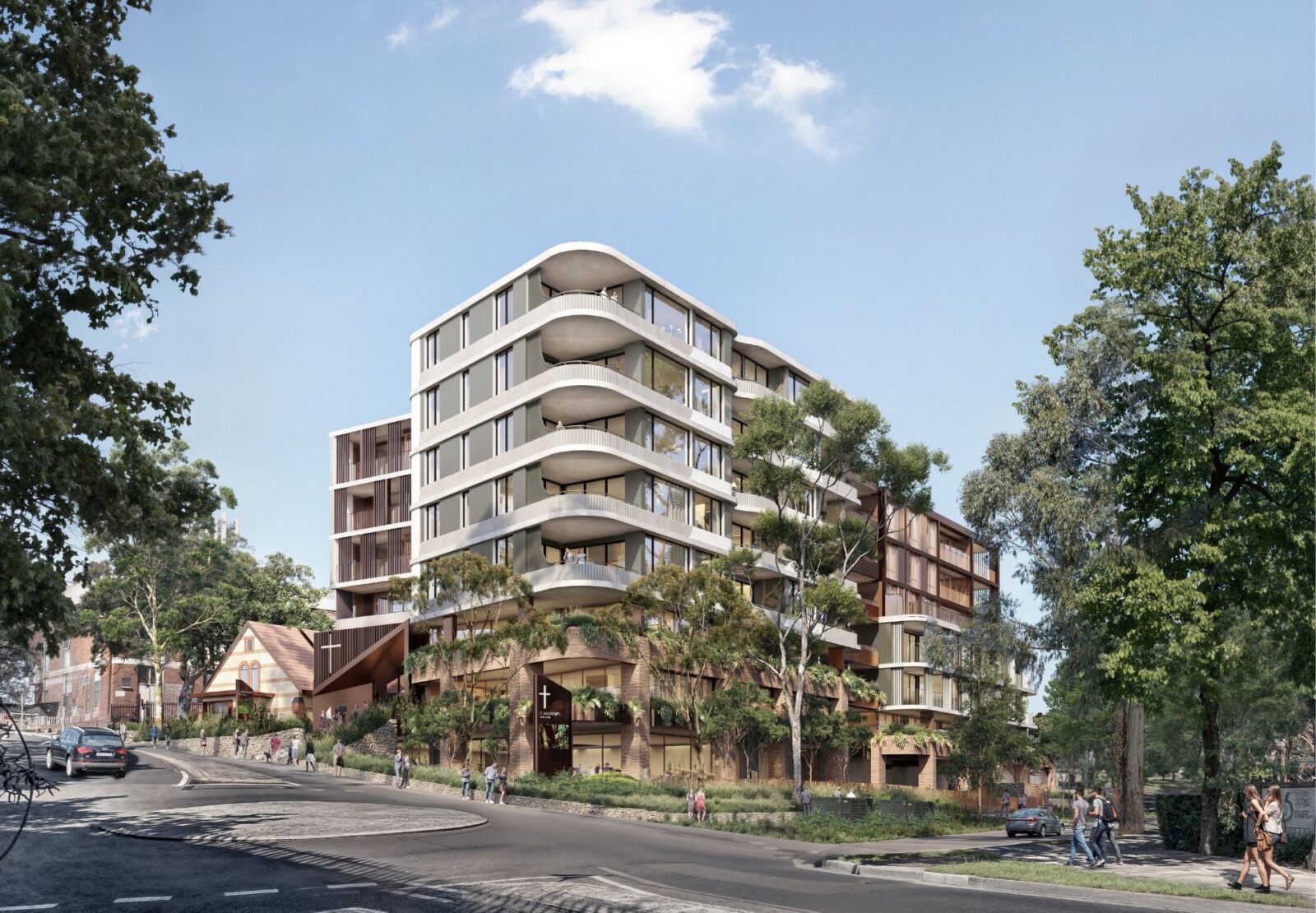
Turning existing parish property into an integrated church and housing development sounds tricky (but a great idea!). Below, Sydney Anglican Property CEO Ross Jones outlines why it’s even more challenging than it seems – especially in the current market. But that’s no reason to lose hope.
If you have even a passing interest in the property market (I’m looking at you, Sydney…), then chances are you’ve heard plenty about the challenges being faced by developers looking to ease the squeeze on housing supply.
Buzzwords like productivity, volatility (and its cousin, uncertainty), (over-)regulation, supply-chain blockages, the cost of finance, and construction costs will be just a few of the terms you’re likely familiar with – or sick of hearing!
But if, like me, you like to simplify things a little, then basically all these (valid) concerns come together under the banner of ‘feasibility’. When a developer says something like: “We just can’t make the project stack!” then what they’re really saying is: “We can’t come up with a project design that delivers both the desired built form AND the necessary financial return to cover our project financing.”
That’s feasibility. And it’s not just the for-profit sector experiencing its challenges, particularly in the current market.
At Sydney Anglican Property (SAP), feasibility is an important gate to determine how or if we proceed with a project, particularly in our Urban Renewal Program that seeks to deliver new and upgraded ministry facilities integrated with social infrastructure on existing church property.
In fact, projects like these are significantly more challenging than straight residential developments because our main focus is on delivering new church infrastructure. From a financial feasibility perspective, every square metre of the development that doesn’t create a financial return (i.e. all of the ministry infrastructure) has to be subsidised by the space that can create a financial return.
We are always playing a balancing act whereby the larger/more expensive the ministry space is, the higher the return needed from the non-ministry areas. In some cases, this will be possible and the project can proceed. In other cases, this isn’t possible and we and the parish are faced with a decision to either:
- reduce the ministry spaces;
- continue to look for higher income generating land uses to cover the ministry space costs; or
- put the project on hold until enough equity can be raised through fundraising or until interest rate/construction cost settings change to be more conducive to proceeding with the development.
The diagram below explains the challenge.
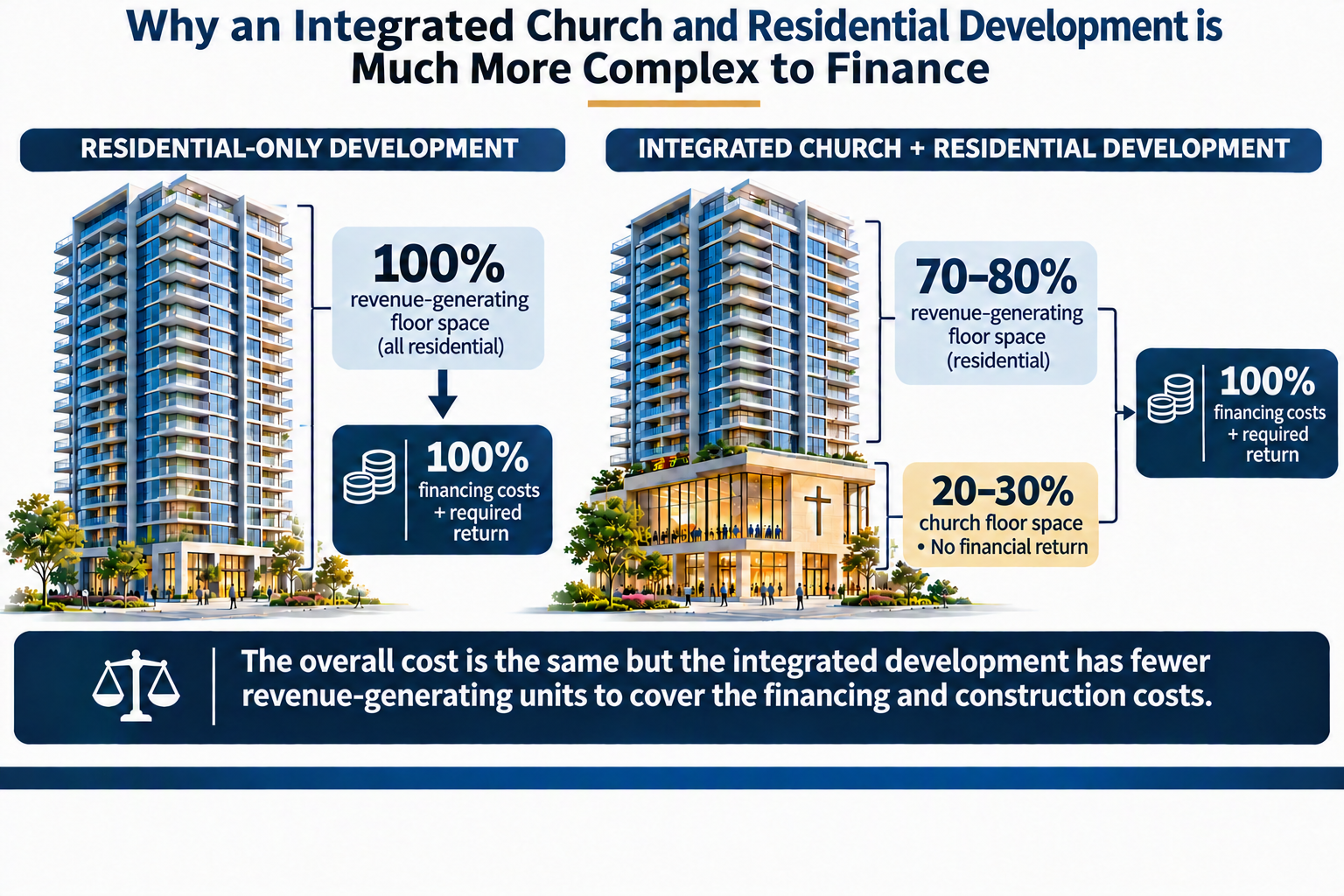
It should be noted that for-profit developers are finding it difficult to make residential projects ‘stack’ financially in suburbs that can’t generate high property sales or rents. In many cases, their planned developments in lower property value suburbs have been put on hold because it will cost them more to build the homes compared to the return they can make through sales. These developments have 100 per cent of the development earning a return.
So, when we try to undertake integrated church/social infrastructure projects in the current economic climate with a big chunk of the development dedicated to ministry space that doesn’t deliver a financial return to pay off debt, it makes it very complex to come up with feasible projects. Of course, we aren’t saying it’s impossible, because we have a God “who is able to do immeasurably more than we ask or imagine.” (Eph 3:20) But the challenges are clear.
While we don’t want to skimp on ministry spaces, we also want parishes to be discerning about the amount of space needed, which is why it’s so important for parishes to have robust ministry and evangelism plans in place. This will allow SAP to be confident that the ministry spaces being sought in the new development are consistent with the parish’s strategies to minister to their congregation and evangelise the local community.
So, why go to all this trouble and complexity? Why not just build churches and not worry about the social infrastructure? In years gone by, some parishes were able to fund or borrow adequate funds for major church upgrades or new builds. However, offertories have not increased at the same rate as construction costs. As a result, the vast majority of parishes have been priced out of the market to build what they need for future ministry. And, contrary to popular belief, the Diocese isn’t awash with cash that it can simply call on to deliver multi-million-dollar church developments!
As a result, project financing has become much more important. By the time any of our projects reaches a DA approval, it will have gone through numerous rounds of feasibility review seeking the right balance of ministry outcomes, community needs, design options, construction methodologies and, finally, sufficient and appropriate income generation to meet debt servicing requirements.
All of this is done in close consultation with ministry staff, other parish representatives, development managers, town planners, private developers, corporate financiers, and (where relevant) government funding agencies. It sometimes makes me wonder how we make any projects ‘stack’ at all!
But in God’s grace, we do, and we are thankful that he goes before us. “In their hearts humans plan their course, but the Lord establishes their steps.” (Prov 16:9)
Of course, with all of those stakeholders, complicating factors and potential hold points, it’s no surprise that some projects ‘simply don’t stack’ despite the best efforts of all involved. Wisdom dictates that it’s better to walk away from an unfeasible project than to try to make it work in the face of evidence to the contrary.
Sometimes it’s obvious from the very earliest stages that a project won’t stack up. While we wish every project was feasible, those ones are the easy ones to handle. Much more difficult are those that only tip over into the unfeasible category much further down the track. And, of course, the risk of this occurring is more pronounced in an environment of rapidly escalating construction and financing costs, like we’re experiencing right now.
I sometimes get asked: “Compared to such a large-scale undertaking, isn’t a smaller project likely to be more feasible?” What that assumption fails to take into account is that a smaller income-generating component means more equity required up front for the church build. If that’s not available, then the income-generating component needs to be of a sufficient scale to service a loan for required ministry facilities.
Either way, there’s no getting around the time-honoured process of feasibility review. Some projects will stack up, others will not. Some will fall over early on, others will make it almost all the way. In my experience, when all parties understand this well and engage collaboratively in the feasibility process, then, no matter where we land, we can all agree it was a good (or at least wise) outcome.